


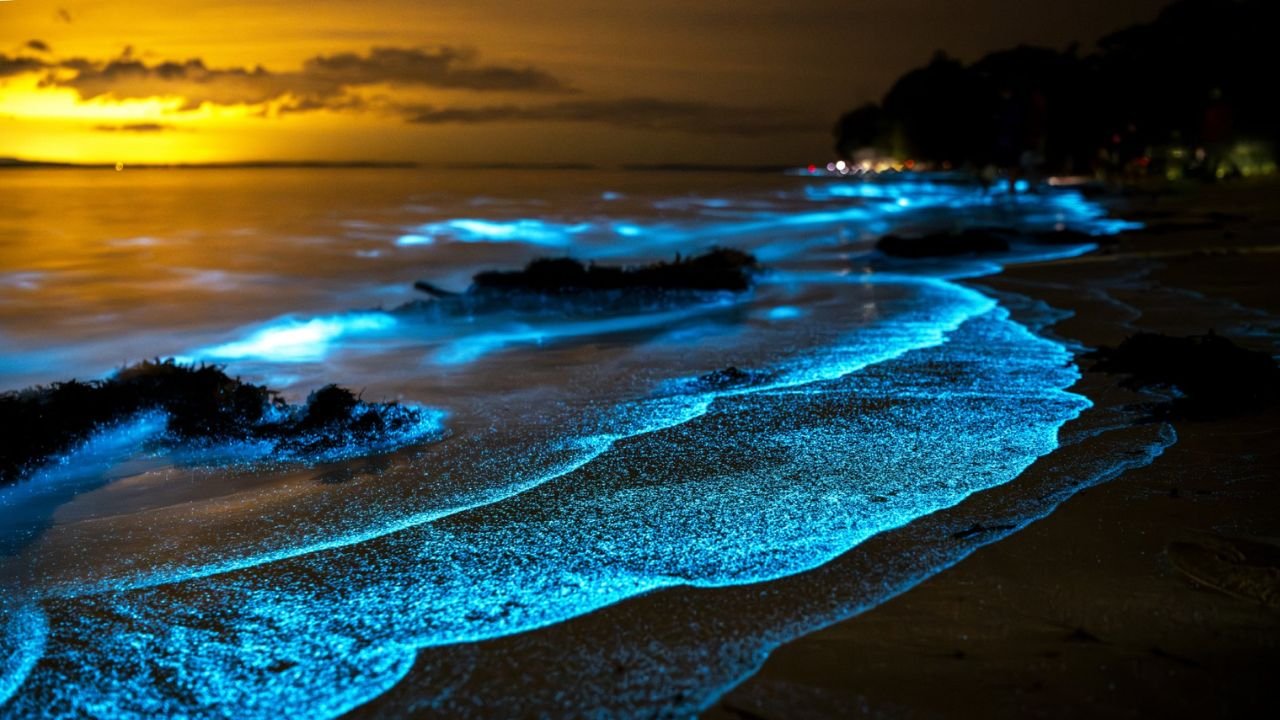
People who witness a glowing beach for the first time often describe it as magical. Waves that sparkle bright blue in the dark, footprints that leave a trail of light on the sand, and shorelines that look like they’re filled with tiny stars — it’s an unforgettable sight. But behind this natural beauty is real science, and researchers say glowing water is more common today than it was years ago.
Glowing beaches, often seen at night, are a result of bioluminescence — a natural light created by living organisms. While these glowing displays can look like something from a movie, the process that creates them is surprisingly simple and fascinating.
This is how “light-up” beaches happen and why they continue to appear in different parts of the world, including the United States.
What exactly causes the ocean to glow?
The glowing effect seen along beaches is caused mostly by tiny microorganisms called dinoflagellates. These are single-celled plankton that float near the surface of warm coastal waters.
When disturbed — by waves, footsteps, or even a boat — they release a quick flash of blue light. This reaction is a natural defense mechanism. Scientists believe dinoflagellates glow to confuse predators, similar to how fireflies use light on land.
In simple terms:
- the ocean glows when tiny organisms react to movement
- each flash is extremely brief
- millions of these flashes together light up the beach
The result is a stunning blue glow that feels almost unreal when seen at night.
Why do some beaches glow more than others?
Not all beaches have the right conditions to produce bioluminescence. Dinoflagellates thrive in warm, nutrient-rich, calm waters. That’s why glowing beaches are often spotted in specific regions or during certain times of the year.
Beaches more likely to glow include those that have:
- warmer water temperatures
- slow or gentle waves
- sheltered bays or coves
- recent algae growth
- minimal light pollution
In the United States, glowing water is often reported in parts of Florida, California, Hawaii, and along certain East Coast shorelines.
How warming oceans increase glowing events
As ocean temperatures rise, scientists are noticing a pattern: bioluminescent events are becoming more frequent. Warmer water helps certain plankton species multiply faster, making them easier to spot at night.
Researchers have seen:
- more glowing waves during summer heat
- glowing events lasting longer than usual
- bioluminescence appearing in new locations
While this makes for beautiful sights, it’s also a reminder of how warming oceans are changing marine ecosystems.
Other marine organisms that produce light
Dinoflagellates are the most common source of glowing beaches, but they’re not the only marine organisms capable of bioluminescence.
The ocean also glows because of:
- jellyfish
- certain types of algae
- comb jellies
- marine worms
- some types of fish and squid
Each species produces light in a different way, but most use a chemical reaction involving an enzyme called luciferase. When triggered, it creates the blue-green glow that spreads across the water.
Why the ocean’s glow is usually blue
Many people wonder why glowing beaches shine blue instead of red, green, or yellow. The reason is simple: blue light travels farthest in water.
This wavelength of light:
- appears brightest underwater
- can be seen clearly at night
- spreads through waves more efficiently
So even though the creatures are tiny, the blue glow they produce travels far, making entire stretches of beach shimmer.
Can the glow be harmful?
While glowing water often looks harmless and beautiful, certain types of plankton blooms can be connected to larger algae blooms known as “red tides.” These can sometimes lead to reduced oxygen levels or toxins that affect marine life.
However, the blue glow seen in many popular videos and photos usually comes from less harmful species. In most cases:
- people can walk near the glowing water safely
- the glow does not affect skin
- the phenomenon disappears naturally
Still, officials sometimes monitor glowing water to ensure it isn’t linked to harmful algae growth.
Why glowing beaches appear mostly at night
Bioluminescence is best seen in darkness because:
- sunlight makes the glow invisible
- nighttime waves create the movement needed to activate the light
- coastal areas are calmer and clearer after sunset
On very dark nights or in remote areas without city lights, the glow appears stronger and more dazzling.
Can glowing beaches be predicted?
Unlike weather forecasts, predicting a glowing beach is difficult. These events depend on water temperature, algae levels, tides, and timing — many of which change day to day.
But scientists and local communities use certain clues:
- warm, calm nights
- recent algae growth
- reports of glowing waves nearby
- clusters of plankton near the surface
Sometimes, glowing beaches last only a few hours. Other times, they may appear for several nights in a row.
A natural wonder shaped by the ocean’s rhythms
The glowing beaches that amaze people today are the result of tiny organisms working together in perfect harmony with the ocean. As water warms and conditions shift, these bioluminescent displays become more noticeable in different parts of the world.
Whether seen from a boat, the shoreline, or simply while walking along the sand at night, glowing water is a reminder of how mysterious and beautiful the ocean can be — and how many of its secrets are still waiting to be discovered.
