


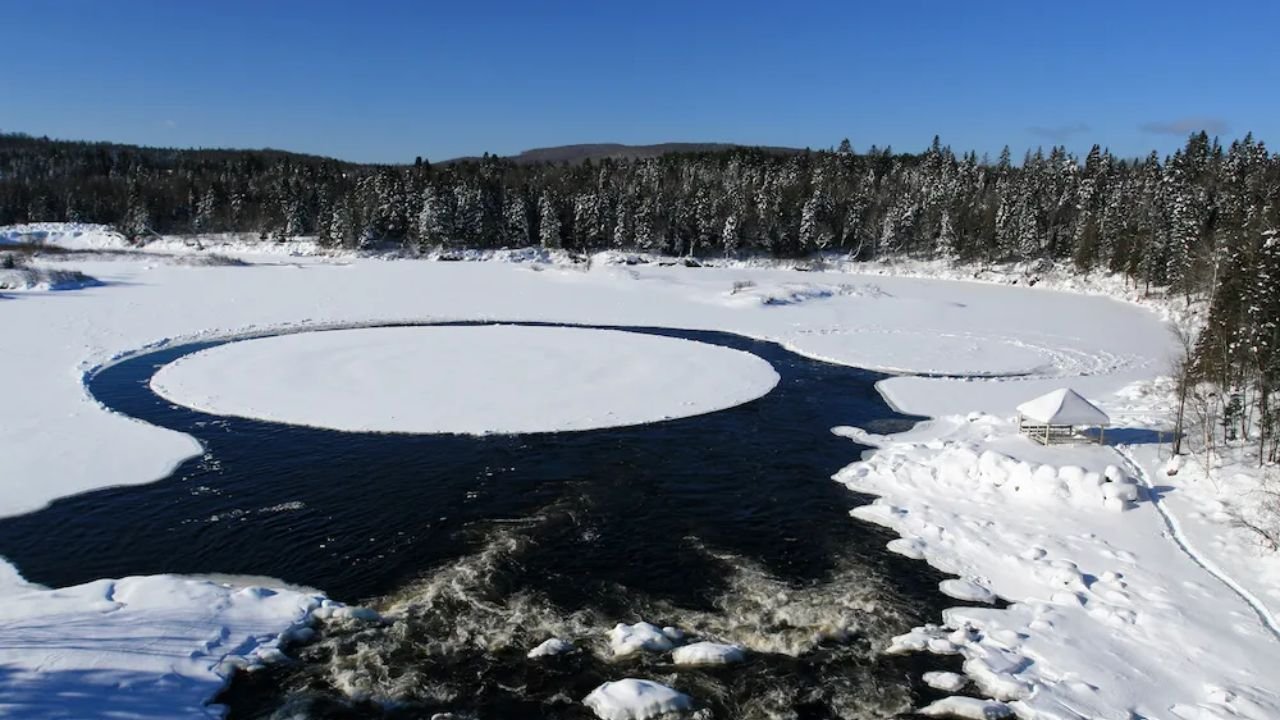
Perfectly circular ice formations have become one of the most fascinating—and sometimes confusing—natural phenomena seen on lakes and rivers across the U.S. These slow-spinning circles look almost too perfect to be real. Many people who spot them think they’re man-made or a sign of something mysterious happening under the water. But the truth behind these ice circles is even more interesting.
Scientists explain that these formations are rare but completely natural. They happen when a unique combination of temperature, current, and wind comes together at just the right moment. Understanding how these circles form helps reveal just how dynamic frozen lakes really are.
What exactly is an ice circle?
An ice circle is a large, perfectly round sheet of ice that slowly rotates on the surface of a lake or river. They can form in different sizes—some just a few feet wide, others stretching hundreds of feet across.
These circles:
- spin gently in the water
- often stay intact for several days
- appear on calm or slow-moving water
- look like giant disks floating on the surface
Their smooth and precise edges often make them look unnatural, but they are a direct result of natural forces interacting with each other.
The main cause: slow-moving water beneath the surface
The biggest factor behind circular ice formations is the movement of water under the ice. Lakes and rivers are never completely still, even when the surface freezes. Beneath the ice, gentle currents continue flowing.
When the water below rotates slowly or moves around an obstacle—like a bend, a submerged rock, or a bank—it creates a circular motion. As temperatures drop, thin ice that forms on top begins to follow the rotating water beneath.
Over time, this rotation:
- shapes the ice into a perfect circle
- smooths out uneven edges
- allows the ice to gently spin in place
This slow movement is why many people see ice circles turning like giant frozen wheels.
Temperature differences help carve the edges
The edges of ice circles are often strikingly smooth and rounded. This happens because of subtle temperature changes in the water and air.
Here’s how it works:
- the outer edge of the circle melts slightly as it rubs against thicker surrounding ice
- cold air quickly refreezes the melted edge
- this melt-and-freeze cycle repeats as the circle rotates
This natural carving process creates the near-perfect shape that fascinates anyone who sees one.
Wind can assist the spinning motion
Even though currents play the biggest role, wind also helps ice circles rotate. Light winds push gently on the exposed surface of the ice, helping maintain the circular spin.
Strong winds don’t usually create these formations because they break ice apart. But steady, mild winds support the slow rotation needed for a circle to stay intact.
Scientists note that this combination of steady wind, rotating water, and freezing temperatures must happen at the same time—one reason ice circles are rare.
Cold snaps increase the chance of formation
Sudden drops in temperature can make ice circles more likely. When lakes freeze rapidly:
- thin sheets of ice form on moving water
- the ice stays flexible enough to rotate
- circular shaping begins immediately
If temperatures stay consistently cold afterward, the circle becomes stronger and more defined.
These conditions often occur during winter cold snaps in northern U.S. states such as Minnesota, Wisconsin, Michigan, and the Pacific Northwest.
Obstacles in the water can trigger perfect circles
Sometimes a single obstacle beneath the surface helps start the rotation that forms an ice circle. These obstacles can include:
- rocks
- logs
- tree branches
- uneven lake beds
- bends or curves in slow-moving rivers
As water flows around these barriers, it naturally creates a swirl or eddy. This swirling motion helps shape ice into a smooth, spinning circle.
Why these formations have become more noticed recently
Although ice circles are not new, more people have noticed them in recent years. With smartphones and social media, unusual natural events are shared instantly, often going viral.
Many reports come from:
- residents living near rivers or lakes
- drone photographers
- hikers and winter sports enthusiasts
Each winter, new images of ice circles spark curiosity, and many people are surprised to learn they are natural occurrences, not signs of human activity or unusual weather patterns.
Are ice circles dangerous?
Generally, ice circles are not dangerous, but they do indicate unstable ice. Because the ice is rotating, it is usually thin and not safe to walk on. Scientists advise people to enjoy the view from a safe distance.
Standing on or near the circle can be risky because:
- the ice is fragile
- currents underneath may be strong
- the spinning motion weakens the edges
Admiring them from the shore is the safest option.
A reminder of nature’s strange beauty
Perfectly circular ice formations are one of winter’s most surprising natural events. They show how even a frozen lake is full of movement and energy. When water currents, cold temperatures, and gentle winds align just right, nature produces something that looks almost engineered.
These ice circles remind us that lakes and rivers are constantly changing landscapes—even in the coldest months. And each winter, as temperatures drop, there’s always a chance another flawless circle could appear on a quiet stretch of water.
